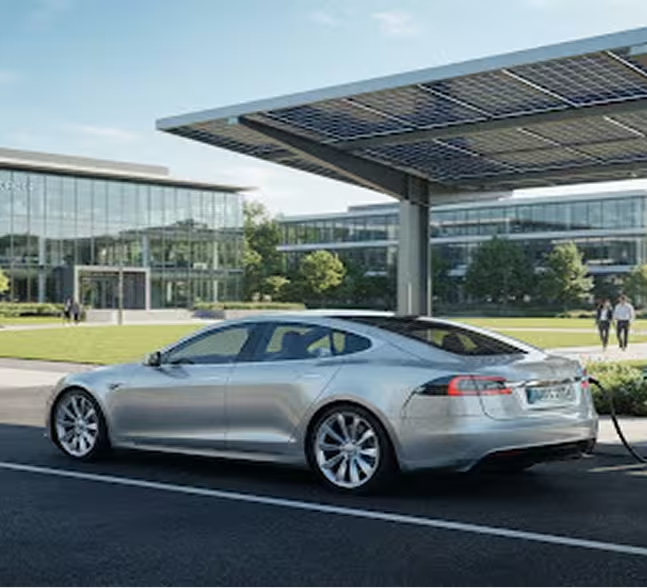
India is at a critical point in its mobility journey. With rapid urbanisation, rising vehicle ownership, growing concerns about air pollution, and ambitious climate goals, the need for sustainable mobility in India has never been greater.
From electric vehicles and public transport to shared mobility and smart infrastructure, India is steadily moving toward a cleaner and more efficient transportation ecosystem. The future of mobility will not simply be about replacing petrol and diesel vehicles with electric alternatives—it will be about creating an interconnected, accessible, affordable, and low-carbon transport system.
In this blog, we explore the future of sustainable mobility in India, the technologies shaping the sector, key challenges, and the opportunities that lie ahead.
What Is Sustainable Mobility?
Sustainable mobility refers to transportation systems that meet people’s travel needs while reducing environmental impact, energy consumption, and dependence on fossil fuels.
A sustainable mobility ecosystem can include:
- Electric vehicles (EVs)
- Public transportation
- Walking and cycling infrastructure
- Shared mobility services
- Battery swapping and charging networks
- Intelligent traffic management
- Renewable-energy-powered transportation
- Mobility-as-a-Service (MaaS)
- Connected and smart transportation systems
The goal is to make mobility cleaner, safer, more affordable, and more accessible while supporting economic growth.
Why Does India Need Sustainable Mobility?
Transportation is closely linked to India’s economic development. People and goods need to move efficiently across cities, towns, highways, and rural areas. However, conventional transportation also contributes significantly to air pollution, greenhouse gas emissions, traffic congestion, and fossil-fuel consumption.
India’s rapidly expanding cities face additional challenges. Increasing congestion and limited road space make simply adding more private vehicles an unsustainable solution.
Sustainable mobility offers an alternative by focusing on efficient movement of people rather than simply increasing the number of vehicles on the road.
A successful sustainable mobility strategy can help India:
- Reduce transport-related emissions
- Improve urban air quality
- Lower dependence on imported fossil fuels
- Reduce congestion
- Make transportation more affordable
- Improve energy efficiency
- Create new jobs and industries
- Support India’s long-term climate objectives
Electric Vehicles Will Be at the Heart of Sustainable Mobility
One of the biggest changes in India’s transportation sector is the growth of electric mobility.
Electric cars, scooters, motorcycles, buses, three-wheelers, and commercial vehicles are increasingly becoming part of India’s mobility landscape.
Two- and three-wheelers are particularly important because they represent a large share of India’s vehicle usage. The electrification of these segments can have a significant impact on urban emissions and operating costs.
The next phase of EV adoption is likely to be driven by improvements in:
- Battery technology
- Charging speed
- Driving range
- Vehicle affordability
- Charging infrastructure
- Battery recycling
- Fleet electrification
However, electric vehicles should be viewed as one component of sustainable mobility rather than the entire solution.
Public Transportation Will Become More Important
If India wants to achieve truly sustainable urban mobility, strengthening public transportation in India will be essential.
Metro rail, buses, suburban rail, and other mass-transit systems can move large numbers of people while using significantly less road space per passenger than private vehicles.
The future will increasingly focus on making public transport:
- Reliable
- Affordable
- Comfortable
- Safe
- Accessible
- Digitally connected
Electric buses can further improve the environmental performance of public transportation, particularly when combined with cleaner electricity generation.
The key opportunity is not only to build more public transport but also to make different modes work together seamlessly.
The Rise of Multimodal Transportation
The future commuter may not rely on a single mode of transport.
Instead, a typical journey could involve walking or cycling to a bus stop, taking an electric bus to a metro station, travelling by metro, and using a shared electric vehicle or bicycle for the final kilometre.
This is known as multimodal mobility.
Better integration between buses, metros, trains, taxis, auto-rickshaws, bicycles, and shared mobility services can make sustainable transportation more convenient.
Digital platforms can support this transformation by allowing users to discover routes, compare transportation options, make payments, and plan complete journeys through a connected mobility experience.
Shared Mobility Can Reduce Private Vehicle Dependence
Ride-sharing, car-sharing, bike-sharing, and shared auto-rickshaws can play an important role in reducing the number of privately owned vehicles on the road.
Instead of every commuter owning a vehicle that remains parked for much of the day, shared mobility allows transportation resources to be used more efficiently.
The combination of shared mobility and electric vehicles could be especially powerful.
For example, electric ride-hailing fleets and shared electric two-wheelers could provide affordable transportation while reducing emissions.
However, shared mobility needs to complement public transportation rather than compete with it. The strongest model is likely to be one where shared services solve first- and last-mile connectivity challenges.
Walking and Cycling Will Shape the Cities of Tomorrow
Sustainable mobility is not only about advanced technology. Sometimes the simplest transportation options can have the greatest impact.
Walking and cycling produce virtually no direct emissions and can improve public health while reducing congestion.
Indian cities can encourage active mobility by investing in:
- Safe footpaths
- Protected cycle lanes
- Pedestrian-friendly streets
- Better street lighting
- Traffic-calming measures
- Bicycle-sharing systems
- Better connections between walking routes and public transport
A city designed around people rather than cars can create a more sustainable and liveable urban environment.
Smart Mobility and Artificial Intelligence
Technology will play an increasingly important role in managing India’s transportation networks.
Artificial intelligence, data analytics, Internet of Things (IoT) devices, connected vehicles, and intelligent transportation systems can help cities understand how people move and respond to changing traffic conditions.
Potential applications include:
- Intelligent traffic signals
- Real-time public transport information
- Predictive maintenance
- Dynamic route optimisation
- Fleet management
- Smart parking
- Traffic-demand forecasting
- EV charging optimisation
For example, real-time data could help transport operators adjust bus frequencies according to passenger demand, reducing unnecessary trips and improving service efficiency.
Battery Technology and Charging Infrastructure
The growth of electric mobility depends heavily on India’s ability to develop a reliable EV charging infrastructure.
Consumers need confidence that they can charge their vehicles conveniently at home, workplaces, parking facilities, highways, and public charging stations.
The industry is also exploring technologies such as:
- Fast charging
- Battery swapping
- Wireless charging
- Smart charging
- Vehicle-to-grid systems
- Battery-management technologies
Battery recycling will become equally important as the number of electric vehicles increases.
Creating an effective battery lifecycle—from manufacturing and use to second-life applications and recycling—can help reduce environmental impact and strengthen India’s domestic EV ecosystem.
Renewable Energy and Electric Mobility
Electric vehicles are only as clean as the energy used to charge them.
This makes the relationship between renewable energy and electric mobility particularly important.
As India’s renewable-energy capacity grows, integrating solar and wind power with EV charging could further reduce the carbon footprint of transportation.
Future charging networks could potentially use smart systems that schedule vehicle charging during periods when renewable electricity is more readily available.
This creates an opportunity to connect two major transitions: clean energy and clean transportation.
Sustainable Mobility in Rural India
The conversation around sustainable mobility should not focus exclusively on major metropolitan cities.
Rural and semi-urban India also needs affordable and reliable transportation for access to education, healthcare, employment, markets, and essential services.
Electric three-wheelers, electric two-wheelers, buses, shared mobility, and improved public transportation can contribute to better connectivity in smaller communities.
The solutions, however, will need to reflect local requirements. Rural mobility may prioritise affordability, long range, durability, and access to charging over the characteristics valued by urban commuters.
Key Challenges Facing Sustainable Mobility in India
Despite significant progress, India faces several challenges on its path toward sustainable transportation.
1. High Upfront Costs
Electric vehicles can have higher initial purchase prices than conventional vehicles, even though their operating costs may be lower.
2. Charging Infrastructure
Charging networks need to expand rapidly while maintaining reliability and interoperability.
3. Battery Supply Chains
India needs resilient and sustainable supply chains for critical battery materials and components.
4. Grid and Energy Requirements
Large-scale EV adoption will increase electricity demand and require effective charging management.
5. Urban Planning
Transportation cannot be separated from land use. Poorly planned cities can encourage longer commutes and greater dependence on private vehicles.
6. Consumer Awareness
Consumers need clear information about EV ownership costs, charging, maintenance, range, battery life, and resale value.
7. Policy Coordination
Central, state, and local governments need coordinated policies covering vehicles, infrastructure, public transport, energy, and urban development.
The Role of Government and Policy
Government policy will remain an important driver of India’s sustainable mobility transition.
Support for electric vehicles, charging infrastructure, domestic manufacturing, battery technology, public transportation, and clean-energy integration can help create the conditions required for long-term transformation.
But policy should increasingly move beyond incentives for individual vehicles.
The bigger objective should be to create a mobility ecosystem where public transportation, walking, cycling, shared mobility, electric vehicles, and digital technology complement one another.
Opportunities for Businesses and Startups
The transition toward sustainable mobility is creating opportunities across the entire value chain.
Businesses can innovate in areas such as:
- EV manufacturing
- Battery technology
- Charging infrastructure
- Battery recycling
- Fleet electrification
- Mobility software
- Fleet management
- Public transportation technology
- Shared mobility
- Smart parking
- Renewable-energy integration
- Vehicle financing and insurance
India’s large domestic market and growing technology ecosystem could make the country an important hub for mobility innovation.
What Will Sustainable Mobility in India Look Like in 2030 and Beyond?
The mobility system of the future is unlikely to be defined by one technology.
Instead, India’s transportation ecosystem will probably become increasingly electric, connected, shared, multimodal, and data-driven.
A commuter could use a single digital platform to plan a journey, combine multiple modes of transport, pay for the trip, and receive real-time updates.
Cities could use data to manage traffic more efficiently. Electric buses could serve high-demand corridors, while shared EVs and micro-mobility options provide first- and last-mile connectivity.
Meanwhile, renewable energy, smarter electricity grids, and battery innovation could make electric transportation increasingly sustainable.
The exact pace of change will vary across cities and regions, but the direction is clear: mobility will need to become more efficient and less dependent on fossil fuels.
Conclusion
The future of sustainable mobility in India is about much more than electric cars.
It is about redesigning the way people and goods move—from private vehicles and congested roads toward a more integrated ecosystem of electric mobility, public transportation, shared mobility, active transportation, renewable energy, and smart technology.
India has an enormous opportunity to build a transportation system that supports economic growth while improving environmental sustainability and quality of life.
The transition will not happen overnight, and challenges around cost, infrastructure, technology, policy, and urban planning will need to be addressed. But with the right combination of innovation, investment, infrastructure, and policy, India can build a mobility future that is cleaner, smarter, more inclusive, and more sustainable.
Frequently Asked Questions
1. What is sustainable mobility in India?
Sustainable mobility in India refers to transportation solutions that reduce environmental impact while providing safe, affordable, accessible, and efficient movement of people and goods.
2. Why are electric vehicles important for sustainable mobility?
EVs can reduce dependence on petrol and diesel and eliminate tailpipe emissions. Their overall environmental benefits increase as electricity generation becomes cleaner.
3. What is the future of EVs in India?
The EV market is expected to expand across two-wheelers, three-wheelers, passenger vehicles, buses, and commercial transportation as technology, infrastructure, and consumer adoption continue to develop.
4. How can public transport support sustainable mobility?
Mass transit can move large numbers of passengers efficiently while reducing dependence on private vehicles, road congestion, and per-passenger emissions.
5. What role will technology play in sustainable transportation?
AI, IoT, connected vehicles, data analytics, digital payments, and intelligent transportation systems can improve traffic management, fleet efficiency, route planning, and the overall passenger experience.
6. What are the biggest challenges to sustainable mobility in India?
Key challenges include upfront vehicle costs, charging infrastructure, battery supply chains, electricity requirements, urban planning, consumer awareness, and coordination between different levels of government.